

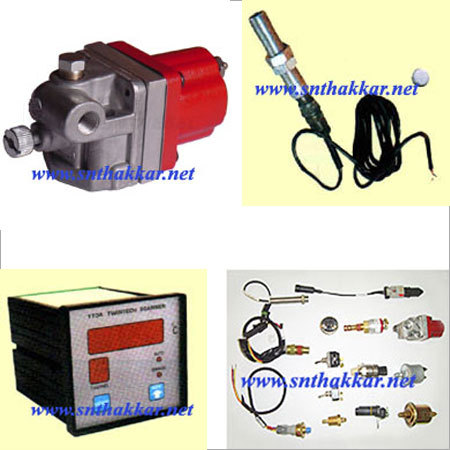
Electrical Mechanical Components
Product Details:
- Alternator Compatible with most standard alternators
- Combustion sysytem Electrical-Mechanical Integration
- Usage Industrial and Automotive Electrical Systems
- Protection IP rated; Fused and insulated
- Frequency 50/60 Hz (for electronic modules)
- Speed Multi-speed Capability
- Rated Output Variable, as per component
- Click to view more
X
Electrical Mechanical Components Product Specifications
- From 500g to 3kg (component dependent)
- New
- Electric Powered
- Compatible with most standard alternators
- Electrical-Mechanical Integration
- Industrial and Automotive Electrical Systems
- Electrical Mechanical Components
- Electric Start
- 50/60 Hz (for electronic modules)
- Multi-speed Capability
- IP rated; Fused and insulated
- Variable, as per component
- Varies per component: 10x8x7 cm (avg.)
- SS
- Mechanical/Electrical Lubrication Compatible
- Designed for Standard Ambient Temperatures
- Panel/Chassis/Bracket mount
- Universal, screw, and plug connectors
- Control Panels, Engine Management, Process Automation
- 12V/24V/230V AC or DC (as per specific module)
- -20C to +70C
- Over 10,000 operating hours (typical)
- Class B/F depending on subcomponent
- RoHS, CE certified for select models
Product Description
Since our inception in the year 1974, we have traveled a long way with a huge customer base. As such, we are dealing exclusively in the Electrical Mechanical Components. These parts are used to run the machines and engine parts smoothly. Besides, these are capable of increasing the performance of your machines. We use the Electrical Mechanical Components made with supreme quality plastics and metal parts.
Features:
- High insulation
- Low consumption of electric energy
- Extensively tested by the experts
Electrical Mechanical Components
- Digital tachometer
- Digital tacho-hour meter
- Magnetic pick up
- Temperature sensor
- Shut down/ shut off valves
- Fuel off solenoid
- Temperature swtiches
- Safety control
- Oil safety control
- Pressure safety control
- Wiring harness
Flexible Voltage Compatibility
Supporting 12V, 24V, and 230V AC or DC input options, these components can be specified to match a variety of global electrical standards and equipment requirements. This flexibility allows them to seamlessly integrate into multiple system designs, enhancing adaptability and simplifying maintenance or upgrades.
Robust Protection and Safety
With certified insulation classes (B/F), IP-rated enclosures, and built-in fuse and insulation systems, these components safeguard critical operations. Their design ensures reliable functioning in both industrial and automotive environments, even under varying temperatures and stresses. They adhere to RoHS and CE compliance for select models.
Advanced Operating Features
Engineered for durability and performance, our components deliver over 10,000 hours of operation and support variable rated outputs. Multi-speed capability and electric start provide operational efficiency, while universal mounting styles and connector types ensure simplified installation across different applications.
FAQ's of Electrical Mechanical Components:
Q: How do I select the appropriate input voltage for my application?
A: You should determine the voltage your system requires-12V, 24V, or 230V-by reviewing your equipment specifications. Our components are designed for easy integration into both low- and high-voltage systems, whether AC or DC, to ensure compatibility with a variety of industrial or automotive applications.Q: What benefits do the insulation classes B and F offer?
A: Insulation classes B and F provide enhanced thermal resistance, supporting prolonged operation at higher temperatures without compromising safety or efficiency. This ensures the components can reliably function within the -20C to +70C temperature range encountered in most industrial environments.Q: When is it necessary to use panel, chassis, or bracket mounting types?
A: The mounting type is chosen based on your installation environment. Panel mounts are ideal for control panels, chassis mounts for secure equipment housing, and bracket mounts for versatile or constrained spaces, making them suitable for diverse automation and engine management layouts.Q: Where are these electrical mechanical components typically used?
A: These components are widely utilized in control panels, engine management systems, and process automation. Their robust design and universal connectors make them suitable for both industrial and automotive scenarios where reliability under varying electrical and environmental conditions is essential.Q: What is the process for connecting these components to existing systems?
A: Installation is simplified thanks to universal, screw, and plug connectors. Start by choosing the correct connector type for your system, securely fit it to the mounting arrangement, and ensure proper insulation and fuse protection according to the supplied technical guidelines.Q: How does electric start and multi-speed capability enhance performance?
A: Electric start ensures rapid, dependable activation of components, reducing manual intervention. Multi-speed capability allows for adaptable operation, granting the system greater flexibility in handling changing process requirements or engine conditions for optimal efficiency.Q: What advantages come with RoHS and CE certification?
A: RoHS compliance guarantees that hazardous materials are minimized, making the components environmentally friendly. CE certification on select models assures conformity to European health, safety, and environmental protection standards, enhancing product reliability and market acceptance.Tell us about your requirement

Price:
Quantity
Select Unit
- 50
- 100
- 200
- 250
- 500
- 1000+
Additional detail
Mobile number
Email


Contact Details

- 2B, Bansilal Building, 64-D, Girgaum Road, Opera House, Mumbai - 400004, Maharashtra, India
- Phone : 08045478256
SATISH N THAKKAR
GST : 27AAAFS0671D1ZJ

- Mr. Satish N. Thakkar (Partner)
- Mobile : 08045478256
- Mr. Virang Thakkar
- virang@snthakkar.net
- Direct Number: +919820399034
 Send Inquiry
 Send Inquiry
 Send SMS
SATISH N. THAKKAR
All Rights Reserved.(Terms of Use)
Developed and Managed by Infocom Network Private Limited.
Developed and Managed by Infocom Network Private Limited.
 English
 Spanish
 French
 German
 Italian
 Chinese (Simplified)
 Japanese
 Korean
 Arabic
 Portuguese